
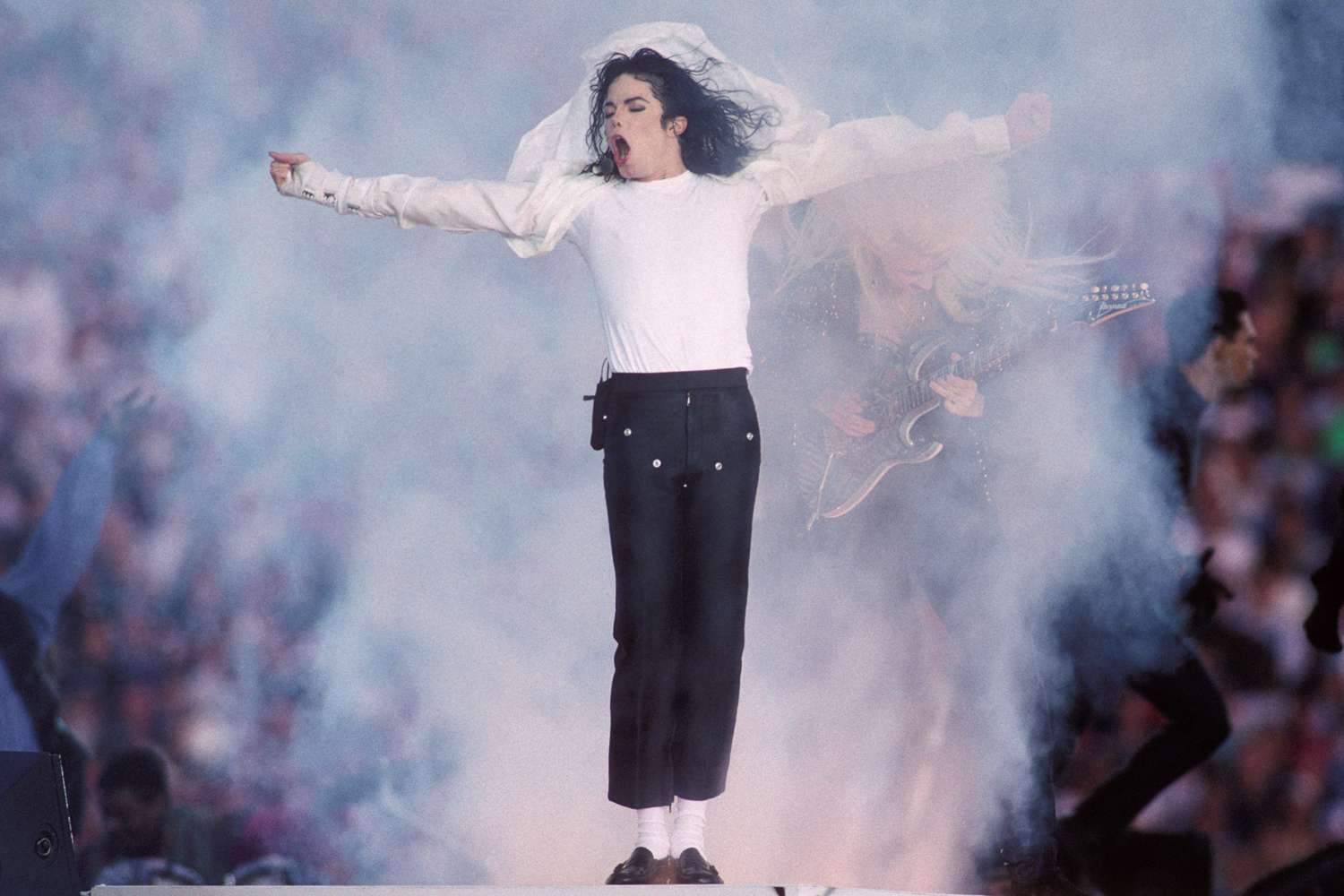
Michael Jackson unexpectedly died on June 25, 2009, weeks before his comeback tour was set to begin
Credit: Steve Granitz/WireImage
NEED TO KNOW
- Michael Jackson died suddenly in June 2009 as he was preparing for his This Is It tour
- His death was ruled a homicide after an autopsy revealed that the singer had died of Propofol intoxication
- His personal physician, Dr. Conrad Murray, was later convicted of involuntary manslaughter
It's been nearly two decades since Michael Jackson died, and fans are still grappling with his sudden passing.
At the time, the King of Pop was prepping for his This Is It tour, which was slated to be his musical comeback after an eight-year hiatus from releasing new music, per Billboard.
Jackson was reportedly struggling with insomnia for months and recruited his on-and-off personal physician, Dr. Conrad Murray, to treat him with the drug Propofol, an anesthetic typically used in hospital settings.
On the morning of June 25, after a particularly long night of insomnia, Murray gave Jackson one final dose of Propofol, which ultimately proved to be fatal. Although Jackson was finally able to sleep, it would be just a matter of minutes until he stopped breathing and went into cardiac arrest.
After finding Jackson unresponsive, Murray attempted to revive him to no avail. In actions that were later called “completely and utterly inexcusable,” it would be almost an hour before paramedics were contacted by one of Jackson's security guards.
Upon arrival, emergency personnel were also unable to revive Jackson, and after being transported to a Los Angeles medical center, he was pronounced dead.
So, how did Michael Jackson die? Here's everything to know about the King of Pop's death, including what happened in his final moments.
How did Michael Jackson die?
Credit: M. Caulfield/WireImage
Jackson's death was ruled a homicide, according to The New York Times.
Following the musician's death, he underwent two autopsies — one performed on behalf of the Los Angeles County Coroner and one arranged by his family, per The Columbus Dispatch.
After the primary autopsy, the coroner concluded Jackson's death was from acute Propofol intoxication, which caused the singer to go into cardiac arrest, NPR reported.
While the L.A. police and prosecutors requested that the complete toxicology report remain sealed, the coroner noted that Jackson also had a “polypharmacy” of drugs in his system. It included the sedatives Lorazepam and Midazolam as well as Diazepam, Lidocaine and Ephedrine, according to Reuters.
Jackson's death was later declared a homicide at the hands of Murray, who administered the fatal dose of Propofol. The doctor was convicted of involuntary manslaughter, with the court ruling his involvement in Jackson's death to be criminally negligent, per The New York Times.
When did Michael Jackson die?
Jackson died on June 25, 2009.
What happened in the time leading up to Michael Jackson's death?
Credit: Kevin Mazur/WireImage
In the months before Jackson's death, he was preparing for his upcoming This Is It tour with rehearsals. Despite his busy schedule, the singer reportedly still struggled with insomnia.
To ease his inability to sleep, he turned to Murray, his personal physician, who had been treating him on-and-off since 2006. Over the course of two months, Murray visited Jackson's home daily to administer medication to aid with sleeping.
In an interview with LAPD detectives acquired by the Los Angeles Times, Murray says he had administered the anesthetic Propofol at the musician's request, explaining that Jackson had admitted to previously using the drug on numerous occasions with other doctors.
Despite Murray's alleged suggestion that Jackson wean off the medication, the musician continued to ask for Propofol.
The night before his death, Jackson had rehearsed at Crypto.com Arena (formerly known as the Staples Center). He completed the rehearsal around midnight and headed back to his home in Holmby Hills, with his team telling Murray to meet there within the hour.
Upon Jackson's arrival around 1 a.m., Murray attempted to help him sleep in a private room of the home.
Murray later told detectives that for the two nights before Jackson's death, he had withheld Propofol in the hopes of taking Jackson off the drug. In the early hours of June 25, Murray gave Jackson Valium and the sedatives Lorazepam and Midazolam instead of Propofol — but nothing seemed to put Jackson to sleep.
By 10 a.m., Jackson was still “wide awake,” and after he continued to beg for Propofol, Murray administered 25mg, about half of what the musician normally received.
Jackson finally fell asleep around 10:40 a.m. and Murray eventually left the room to use the bathroom. When he returned, Jackson was no longer breathing.
While Murray stated that he stepped away for no more than two minutes, phone records revealed that he had spoken to various contacts between 11:07 and 11:51 — suggesting that Murray was either not paying full attention to Jackson or was making frantic calls following the discovery that the singer had stopped breathing.
It would be over an hour before Jackson's staff member and security guard Alberto Alvarez would call 911 at 12:21 p.m.
It's unclear exactly what happened in the time before emergency personnel were called.
While speaking to detectives, Murray claimed to have immediately begun CPR and mouth-to-mouth resuscitation while calling Jackson's assistant to summon the security team — although it was later revealed that the call went to voicemail.
During that time, Murray also allegedly administered an “antidote” in the hopes of reversing the effects of some of the drugs in Jackson's system.
He claims he did not dial 911 because he did not have sufficient information to direct emergency personnel to the home and did not want to take attention away from aiding Jackson.
When Jackson's security team did not immediately arrive, Murray claims to have run downstairs, where he encountered Jackson's personal chef. Shortly after telling her to contact security, Alvarez arrived upstairs.
Murray says he immediately demanded Alvarez dial 911, but Alvarez later noted that Murray concealed medications before emergency services were called.
Murray continued performing CPR with Alvarez's help. When paramedics arrived, they continued to administer aid for 42 minutes before he was transported to Ronald Reagan UCLA Medical Center.
Despite efforts to revive the singer, he was later pronounced dead.
Where did Michael Jackson die?
Credit: Phil Dent/Redferns
At the time of his death, Jackson was at a mansion he was renting in the Holmby Hills neighborhood of L.A., according to the Associated Press (via the Los Angeles Times).
Police later discovered a variety of sedatives and other prescription drugs in multiple vials and bottles around the home, none of which were labeled as prescribed to any patient, the LAPD stated.
After Jackson was discovered not breathing, he was taken to Ronald Reagan UCLA Medical Center by paramedics and was later pronounced dead, per a statement by his family.
How old was Michael Jackson when he died?
Jackson was 50 years old at the time of his death.
What were Michael Jackson's last words?
The last person to speak to Jackson before his death was Murray.
In the time leading up to the tragic moment, Murray told detectives that Jackson begged for the medication Propofol, which the musician referred to as “milk.”
“I'd like to have some milk,” Jackson allegedly told his doctor in some of his final moments. “Please, please give me some.”
How did the public react to Michael Jackson's death?
Credit: Charley Gallay/Getty
News of Jackson's death spread quickly. The BBC reported that major websites, including Twitter and Wikipedia, crashed as millions of people searched for information about Jackson's death.
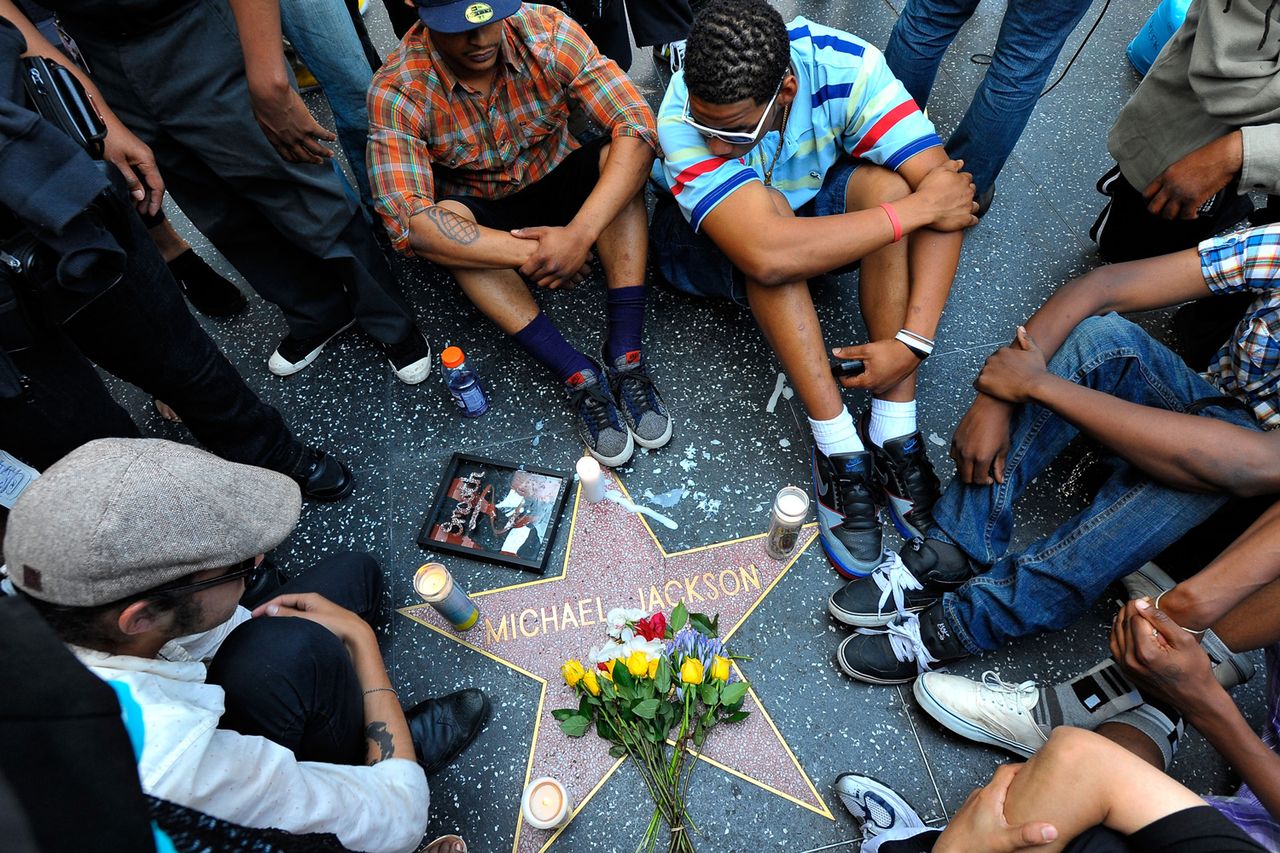
It made front-page news, and tributes immediately poured in from fans who wanted to honor the late star.
In the days that followed, sales of Jackson's music and memorabilia skyrocketed. News outlets devoted round-the-clock coverage to Jackson, and MTV dedicated its programming almost exclusively to the musician.
Fans also held gatherings at spots important to Jackson's career, including Neverland Ranch, the Apollo Theater in New York, his star on the Hollywood Walk of Fame and his childhood home in Gary, Ind., per CBS News.
On July 7, a public memorial service was held at the Crypto.com Arena (formerly Staples Center), which hosted 11,000 fans inside the venue as well as 6,500 more at another nearby venue.
Over a million fans had applied for tickets to the service, which were eventually distributed via an online lottery. The event was attended by numerous celebrities, including the Kardashian family, and featured performances from Lionel Richie, Stevie Wonder and Mariah Carey.
Then on Sept. 3, a private burial service was held at Forest Lawn Memorial Park in L.A., CBS News reported.
It was attended by family and close friends, like his ex-wife Lisa Marie Presley, as well as Macaulay Culkin, Eddie Murphy and Elizabeth Taylor.
Were criminal charges filed following Michael Jackson's death?
Credit: GABRIEL BOUYS/AFP via Getty
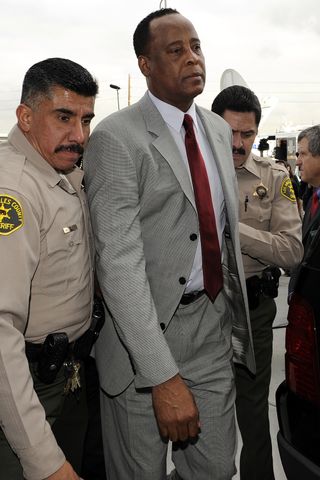
Following Jackson's autopsy by the L.A. County Coroner, which ruled Jackson's death a drug overdose homicide, attention turned toward his physician.
While Murray denied any wrongdoing, he was interviewed by LAPD detectives, and his Texas clinic was searched as part of the ongoing investigation, Murray's lawyer said in a statement.
Murray surrendered to an L.A. courthouse on Feb. 8, 2010, where he pleaded not guilty to the charge of involuntary manslaughter, per CNN. His bail was set at $75,000, and he was later released.
The trial officially began on Sept. 27, 2011, when experts and witnesses spoke out about Jackson's death.
While defense attorneys tried to claim that Jackson caused his own death by potentially taking a fatal dose of drugs while Murray's back was turned, the prosecution called the doctor's treatment of Jackson “inexcusable” and “difficult to comprehend.”
During the trial's opening day, the prosecutor said Murray “repeatedly acted with gross negligence, repeatedly denied care, appropriate care, to his patient, Michael Jackson, and it was Dr. Murray's repeated incompetent and unskilled acts that led to Michael Jackson's death.”
The prosecution condemned Murray's decision to administer Propofol in a home setting without proper monitoring equipment, using the toxic anesthetic as treatment for insomnia, and waiting an extended time to call 911.
After several weeks of testimony, the jury deliberated for 10 hours. On Nov. 7, 2010, Murray was found guilty of involuntary manslaughter, according to The New York Times.
He was sentenced to four years in prison, although he was released after two years, per NPR.
Read the full article here