

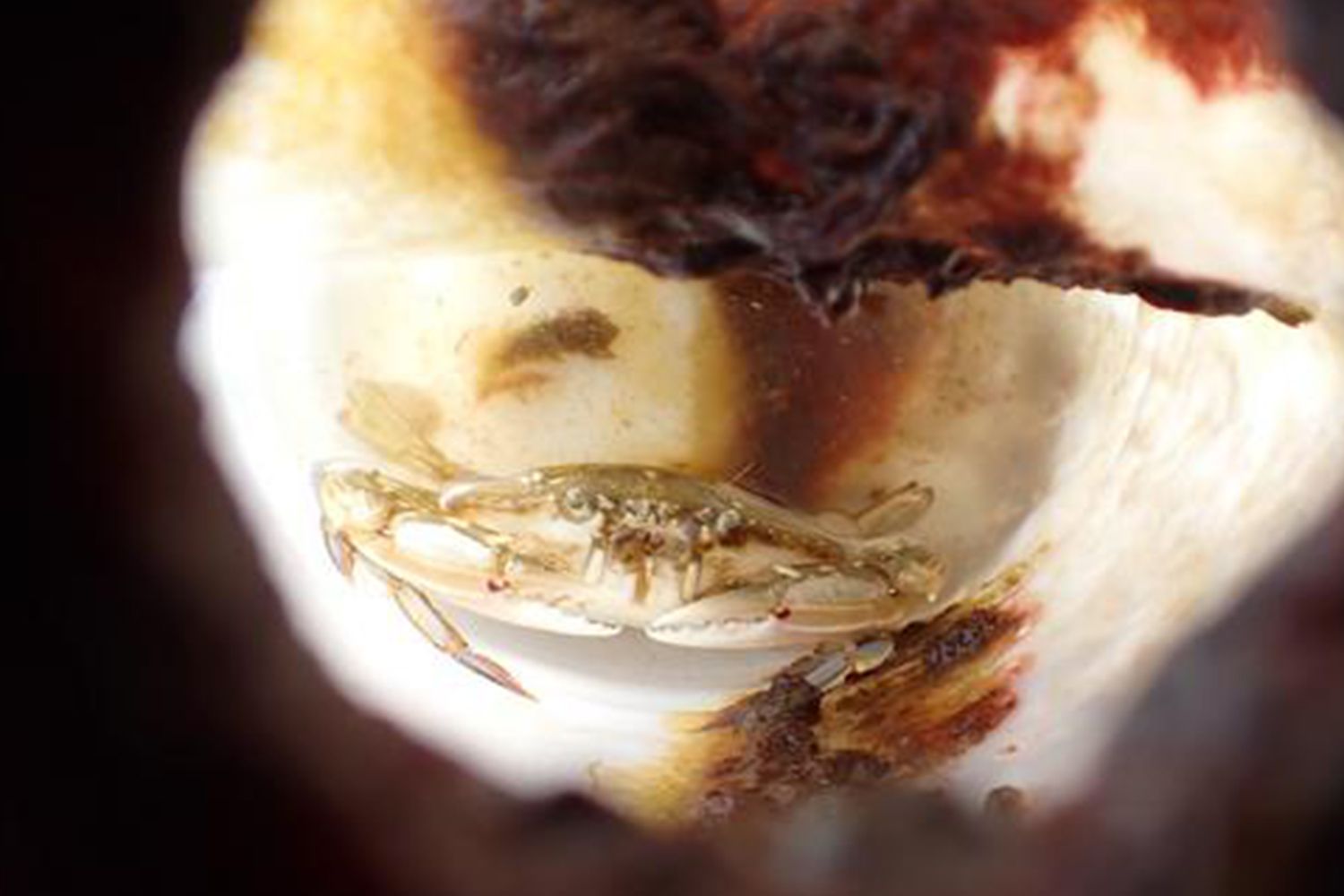
Researchers say the swimming crab likely entered the bottle as a juvenile before growing too large to squeeze back through the opening
Credit: Hajime Sato / Hiroshima University
NEED TO KNOW
- Researchers found a live crab trapped inside a floating plastic bottle off the coast of Japan
- The was tiny when it got inside the bottle, but grew too large to fit back through the narrow opening, scientists say
- A new study reconstructed how the animal survived for roughly two months by feeding on fish and algae inside the bottle
When researchers spotted a plastic bottle drifting in the Pacific Ocean, they expected to find small fish sheltering around it.
Instead, they discovered a live crab trapped inside.
The unusual encounter happened during a juvenile fish survey off Okinawa, Japan, when scientists from Hiroshima University spotted a floating Shaoxing wine bottle surrounded by young fish. Looking closer, they found a large swimming crab living inside — even though the bottle's opening was far too small for the animal to fit through.
“During juvenile fish surveys in offshore waters, we happened to encounter a floating plastic bottle… with many juvenile fish associated with it,” study authors Hajime Sato and Yoichi Sakai said in a statement. “To our surprise, a large live swimming crab, Portunus sanguinolentus, was trapped inside the bottle. The crab was clearly larger than the opening of the bottle!”
Their findings set off a scientific mystery: How did the crab get inside, and how had it survived?
The bottle's manufacturing date provided the first clue. It had been produced in November 2021 and was recovered in July 2022. Researchers also examined goose barnacles attached to the bottle's exterior, analyzed DNA from the crab's stomach contents and studied algae growing inside the bottle.
Together, the evidence suggested the crab had entered the bottle as a juvenile through its 24 mm-wide opening. Over the next two months, it survived by eating juvenile fish sheltering around the floating debris, along with algae growing inside the bottle, before becoming too large to escape.
Never miss a story — sign up for PEOPLE's free daily newsletter to stay up-to-date on the best of what PEOPLE has to offer, from celebrity news to compelling human interest stories.
The researchers said the crab's predicament reminded them of Salamander, a famous short story by Japanese author Masuji Ibuse about an animal that grows too large to leave its home.
“Plastic bottles discarded by humans can trap crabs and prevent their escape,” the researchers said. “Through this striking example, we would like readers to recognize that objects that make our lives more convenient can sometimes have unexpected effects on small marine animals, while also appreciating the remarkable vitality of the swimming crab.”
Read the full article here