
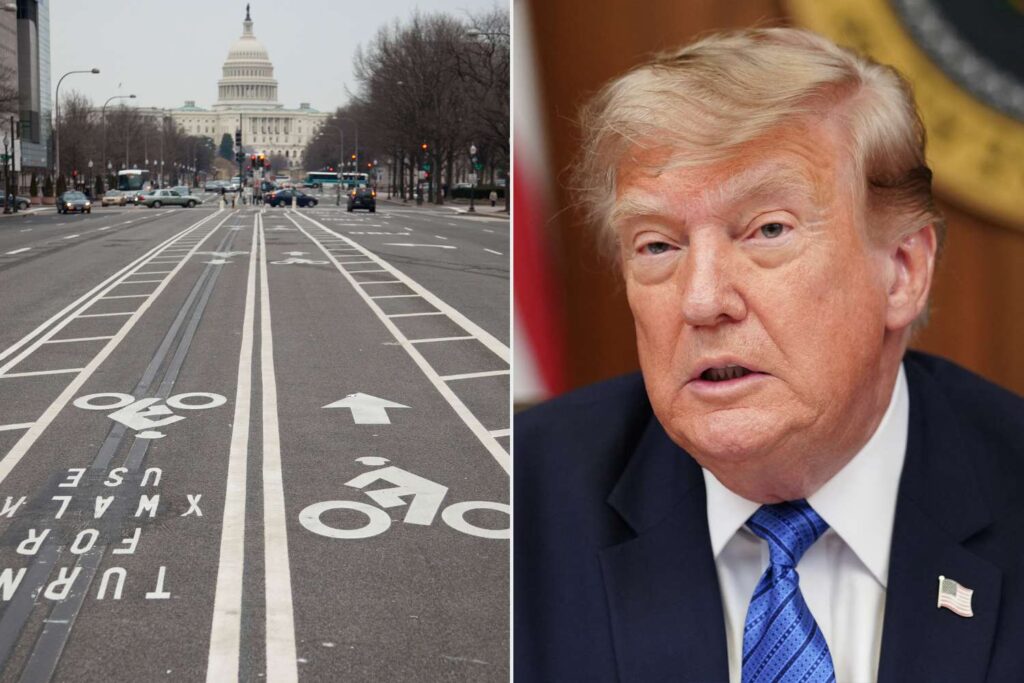
Bike lanes were part of what Transportation Secretary Sean Duffy once referred to as “DEI pet projects”
Credit: Brooks Kraft LLC/Corbis via Getty; Aaron Schwartz/AFP via Getty
NEED TO KNOW
- The Trump administration has rescinded funding for bike lanes, calling them “DEI pet projects”
- Safety resources for cyclists, including crash analysis tools, have reportedly been removed or edited by federal agencies
- Cities face uncertainty as grants for bike lanes and road safety projects are frozen or canceled nationwide
Since taking office, the Trump administration has slashed federal funding for projects endorsed by the previous administration, including bike lanes, which Transportation Secretary Sean Duffy once lumped in with other “DEI pet projects.”
In July, the Trump administration announced that $1.73 billion in infrastructure grants would be awarded through the Department of Transportation to improve roads and bridges, although under Trump’s predecessor Joe Biden, the department’s funding included bike lanes.
Shortly after news of the grant, Duffy wrote in part via X, “I just redirected $1.73 billion in USDOT grants away from Biden-era DEI pet projects,” including “DEI bike lanes” and “climate change.”
“Now this funding is officially locked in to fix America’s actual backbone: ROADS, BRIDGES, AND SHIPPING PORTS,” he continued.

Credit: Tierney L. Cross/Bloomberg via Getty
Weeks later, NPR reported that safety resources for bike riders had been taken down or edited, citing an analysis involving the Internet Archive’s Wayback Machine and internal Federal Highway Administration (FHWA) emails.
One of the resources pulled was the Pedestrian and Bicycle Crash Analysis Tool, which was designed to capture information on cars, bicycles, and pedestrians, according to the outlet.
The outlet reported that the FHWA had removed bike lanes and speed cameras as a set of recommendations from a list of “proven safety countermeasures” that had been shown to improve road safety.
In an email statement to NPR, a DOT spokesperson said it “continuously reviews its policies to ensure each promotes safety, efficiency, and common sense.”
“Since nearly 80% of the population uses cars to get to work and their important medical appointments, we are taking a closer look at federal guidance to ensure American families have the infrastructure they need,” the statement said, per the outlet. “This is a common sense approach despite the Left’s belief that everyone should ride a bike to their shoebox-sized apartment to eat crickets to achieve a phony climate agenda.”
The Trump administration has also canceled grants intended to improve street safety measures.
Last September, funding was rescinded from a San Diego County road improvement project that included bike lanes, as it “appears to reduce lane capacity and a road diet that is hostile to motor vehicles,” Bloomberg reported.
It was also reported that Fairfield, Ala.’s intent to convert street lanes to trail space on Vinesville Road was seen as “hostile” to cars and “counter to DOT’s priority of preserving or increasing roadway capacity for motor vehicles,” according to the outlet.
A similar issue was seen in Boston when grants meant to improve transit around the city’s Mattapan Square neighborhood and at city intersections were rescinded, per the outlet.

Credit: Kent Nishimura / AFP via Getty
This year in Washington, the Trump administration announced it was tearing out the 15th Street bike lane as “part of the president’s initiative to revitalize” the city, according to The New York Times.
The demolition plan was then temporarily blocked in April by Judge Amy Berman Jackson, citing an “absence of reasoned decision-making,” per the outlet.
NEED TO KNOW
Never miss a story — sign up for PEOPLE’s free daily newsletter to stay up-to-date on the best of what PEOPLE has to offer, from celebrity news to compelling human interest stories.
The future of bike lanes in Nashville is also uncertain, as the East Nashville Spokes project is in the midst of a court battle after the Trump administration froze a $9.3 million grant, according to The New York Times.
“For this administration to come in and say, ‘Yes, I know the agency said yes to you last year, but now we are going to pull it back,’ creates a huge amount of uncertainty for cities and towns and communities that have invested in planning and identifying safety concerns or areas for economic growth,” Caron Whitaker, deputy executive director for the League of American Bicyclists, told The Guardian. “It slows the safety improvements … It reduces those improvements to quality of life.”
Read the full article here