

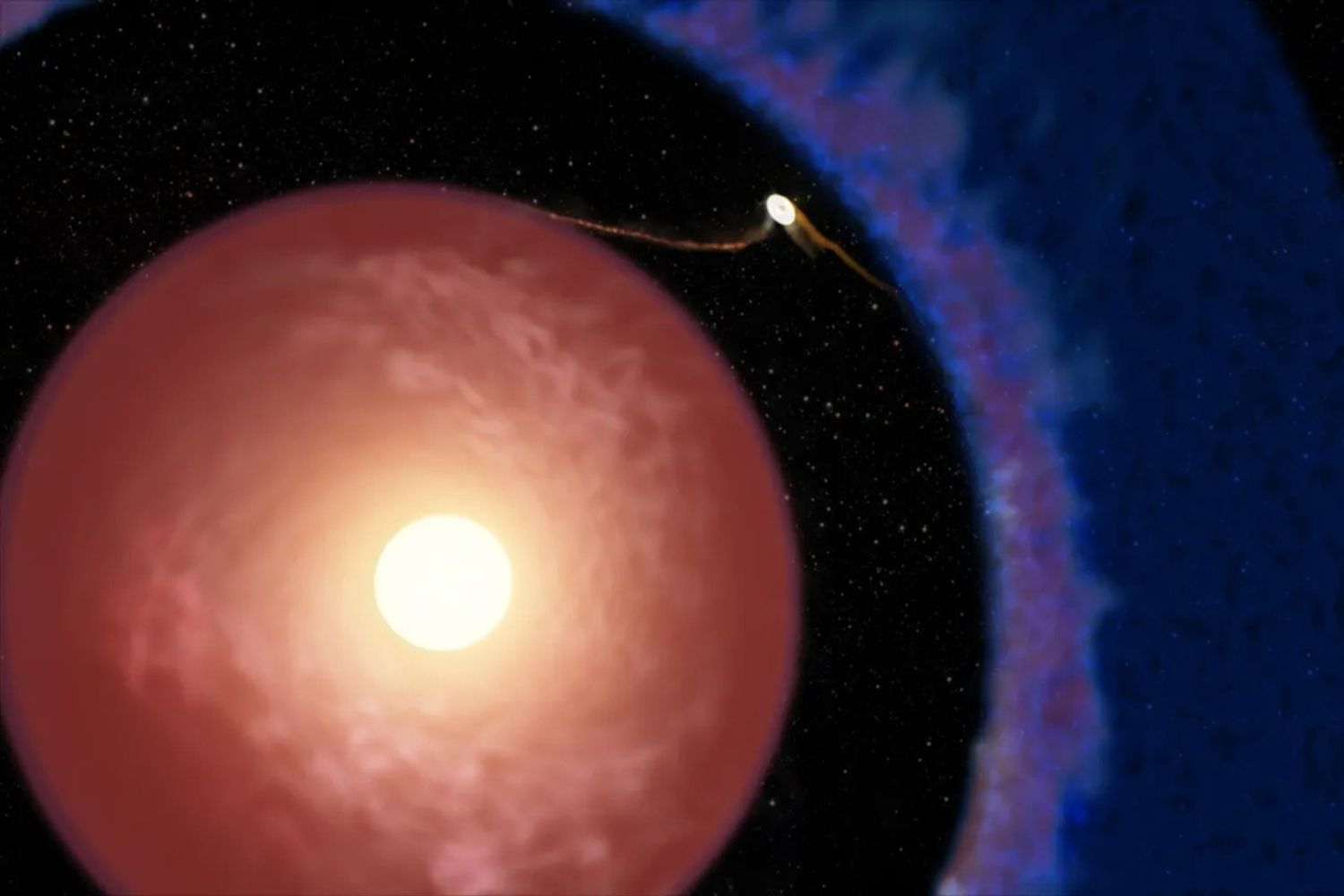
The exoplanet, known as Elias 2-24 b, is about the size of Jupiter — and it’s still forming
Credit: W. M. Keck Observatory/Adam Makarenko
NEED TO KNOW
- Elias 2-24 b is the youngest planet ever discovered
- The planet, about the mass of Jupiter, is still forming in a disk of gas and debris
- “This is just the beginning of a new era of discovery,” Lucas Cieza, a professor at the Instituto de Estudios Astrofísicos in Chile and co-author of the study, said
Astronomers have confirmed what is now the youngest known planet ever discovered, identifying a world that is less than a million years old and still taking shape around its young star.
The planet, known as Elias 2-24 b, is roughly the mass of Jupiter and sits about 450 light-years from Earth, according to NASA.
Unlike most of the other 6,000 confirmed exoplanets — a term used for planets outside of the Earth’s solar system —which are billions of years old, Elias 2-24 b is still embedded in the dusty disk of gas and debris left over from its star’s formation.
Researchers found the planet inside a prominent gap in a location where scientists expected a forming planet to be.
“The planets should be found within the gaps, since they are carving them,” said Andrea Bernardi, the lead author of the study published on Wednesday in The Astrophysical Journal Letters. “And that’s exactly where we found Elias 2-24 B.”
By combining archival observations from the W. M. Keck Observatory taken in 2018 and 2020, researchers were able to track the object’s movement and confirm that it was behaving like a planet rather than a background star or imaging artifact.
“We usually hear about telescopes working separately, but this confirmation was possible only by using multiple telescopes together,” said Bernardi. “Elias 2-24 b is at the limit of what current telescopes can detect, but with new instruments like NASA’s Nancy Grace Roman Space Telescope, such detections should become easier.”
The discovery could give astronomers a rare look at the earliest stages of planetary formation and help refine theories about how giant worlds like Jupiter come together.
“Our planet-formation models already struggled to explain the previous record holders for the youngest known planet — a four-way tie between two planets orbiting the star PDS 70 and two planets orbiting the star WISPIT 2 — which are all more than 5 million years old,” said Lucas Cieza, a professor at the Instituto de Estudios Astrofísicos in Chile and co-author of the study.
Never miss a story — sign up for PEOPLE’s free daily newsletter to stay up-to-date on the best of what PEOPLE has to offer, from celebrity news to compelling human interest stories.
“Elias 2-24 B shows us that even our best planet-formation models are still missing some important processes,” he continued.
“This is just the beginning of a new era of discovery,” Cieza added. “It’s incredible that with modern technology, we are actually able to see planet formation in action, and Roman will take planet hunting to the next level.”
Read the full article here