

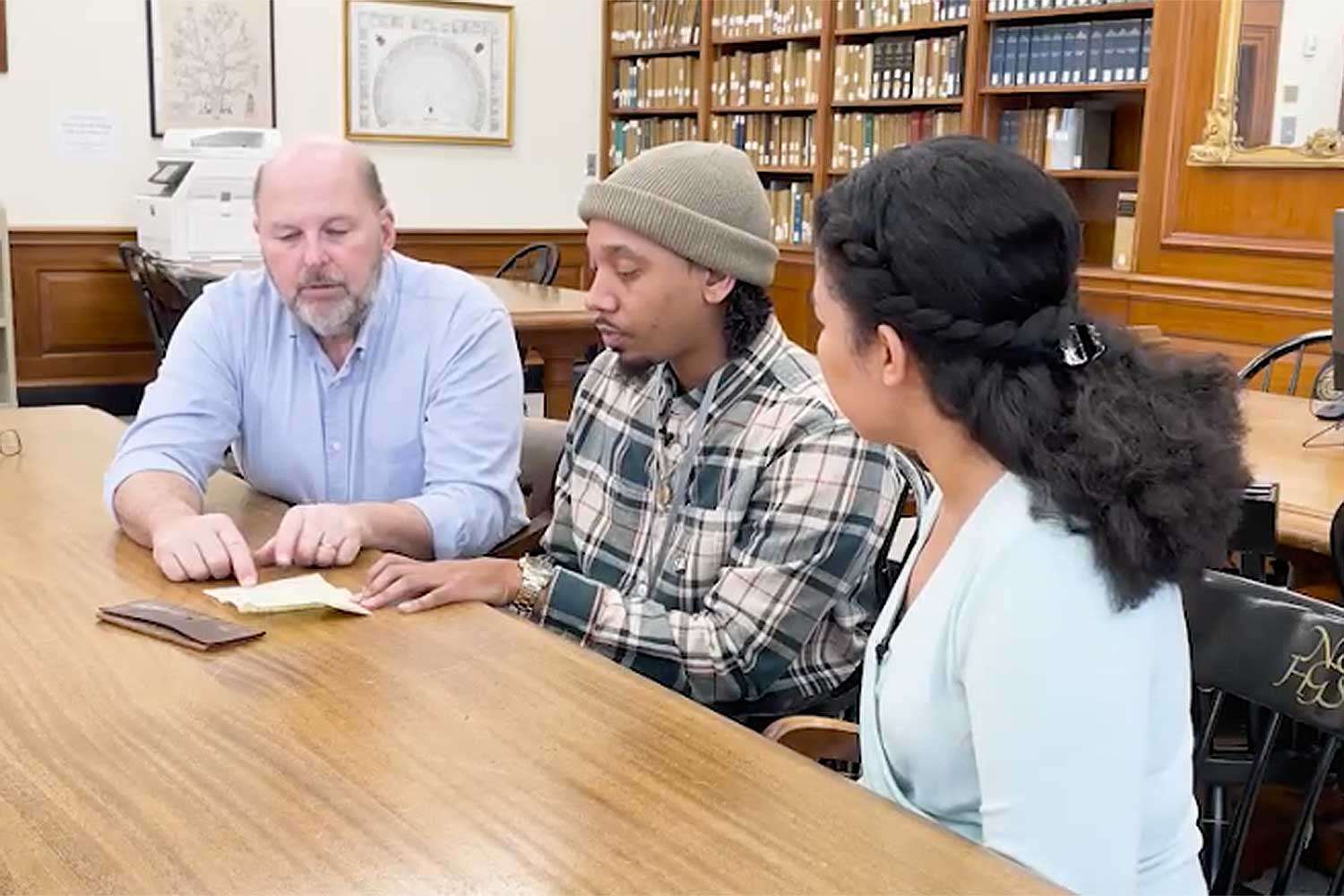
Freedom papers were carried by free Black Americans before the Civil War
Credit: WCVB Channel 5 Boston/YouTube
NEED TO KNOW
- A Boston man discovered a relative’s freedom papers while cleaning out his mother’s home
- Freedom papers were carried by free Black Americans before the Civil War to prove that they were not escaped slaves
- Failure to carry the document could result in recapture and enslavement
A Boston man made a priceless discovery while helping his mom clean out her home — an ancestor's freedom papers.
Aaron Haynes first found the document in 2020 during the COVID-19 lockdown, per WCVB 5.
He said he found a small leather pouch containing a folded piece of paper, but he didn’t initially know what it was.
“I opened it up and looked at it and was very confused as to what this might be,” he recalled while speaking to the outlet. “And [my mom] said, 'That’s your ancestor’s freedom papers.' And I said, 'Hold on!' "
Freedom papers were certificates confirming that a Black person was legally free. They were most common from the late 1700s through the mid-1800s, when both free and enslaved Black Americans lived in the same regions.
Carrying the papers was necessary to avoid being mistaken for an escaped slave, and therefore a fugitive, according to the National Museum of African American History and Culture.
Haynes decided he wanted to learn more about the document, and so he took it to American Ancestors, a nonprofit dedicated to family history and genealogy research.
He sat down with conservator Todd Pattison and historian Danielle Rose, who verified the authenticity of the certificate, per WCVB 5.
The document, which originally belonged to a man named Samuel Jones, stated that Jones was 21 at the time the paper was signed. It also declared that he was born and raised a free man in Anne Arundel County, Md.
“A lot of free Black people wanted, needed, to carry these documents so that they could avoid potential recapture, kidnapping, back into enslavement," Rose explained in a filmed video segment for the outlet.
The document also stated that Jones was 5 feet, 7 inches tall and had a light complexion. He also had a small scar on his left hand.
For Haynes, the paper is a reminder of both his family’s legacy and of personal empowerment.
"Knowing that probably I’m here because he did this step … Just a feeling of being grateful of what I have, and feeling grateful for what my family has been through and knowing that through these trials and tribulations we can just overcome any obstacle,” he said.
He added, "I haven’t realized just how much it just weighs in on [not] just the history of … my family, but of this country itself. And what it means to be … an African American man — knowing that I have a relative’s freedom papers.”
Pattison and Rose noted that finding a document of this type is especially rare.
“Generally, we don’t have as much material from more marginalized people, from people that didn’t have access to collections and weren’t collected by institutions," Pattison told WCVB 5.
"I think there has been a bias in institutional collecting that we collect, you know, Founding Fathers materials, and we collect [from] wealthy people because we have historically tried to tell that story,” he continued.
Never miss a story — sign up for PEOPLE's free daily newsletter to stay up-to-date on the best of what PEOPLE has to offer, from celebrity news to compelling human interest stories.
“The more documents that you can find for African Americans, especially before the end of the Civil War, it’s a real treasure," Rose added.
“These names were hidden for a very long time, purposefully obscured, and so just locating the names is a huge effort. I think a lot of people don’t think about what they may have in their home when it comes to contributing to history,” she said.
Read the full article here