
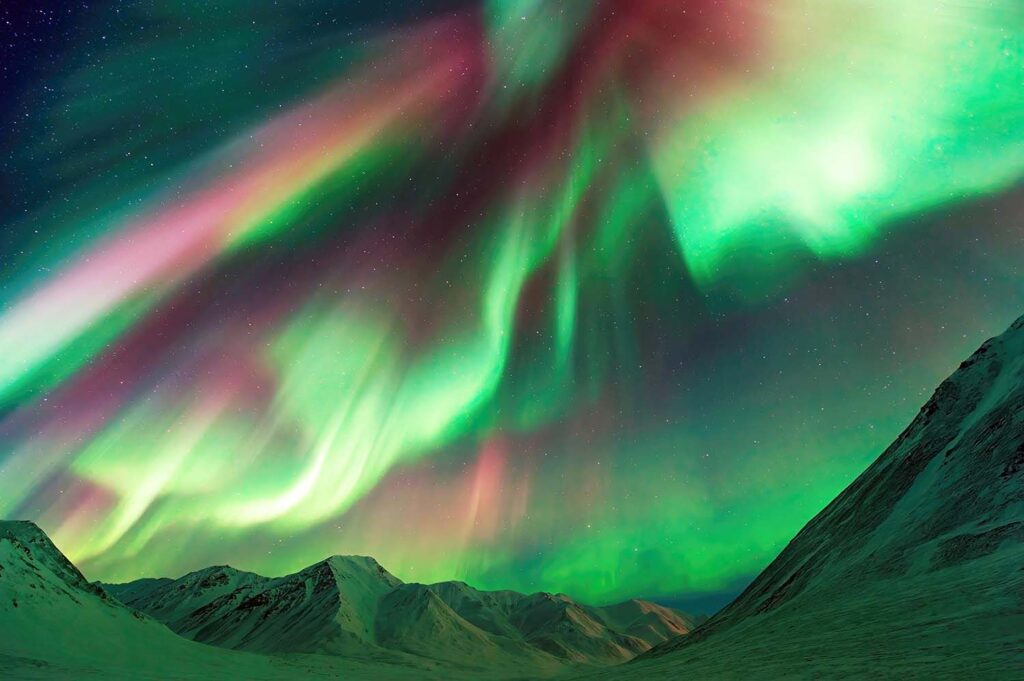
NOAA forecasters predict a Kp index around 4 on its nine-point scale tonight, Aug. 17, giving skywatchers in northern U.S. states a glimpse of the aurora
Credit: Getty
NEED TO KNOW
- The northern lights may be visible in parts of the northern U.S. tonight due to increased geomagnetic activity
- NOAA forecasts the best viewing in dark, cloud-free areas near the Canadian border between 10 p.m. and 2 a.m.
- Smartphone cameras can capture the auroras using night or pro mode for long exposure shots without professional gear
Look up tonight, because the cosmos is bringing a little extra sparkle!
The northern lights could shimmer across portions of the northern U.S. on Monday, Aug. 17, as geomagnetic activity becomes active enough to give some skywatchers a glimpse of the stellar display.
The northern lights (aurora borealis) are a result of geomagnetic storms, which occur when charged particles from the sun collide with gases in the Earth’s atmosphere, creating brilliant waves of light in the sky. Still, their visibility depends on several factors, including intensity and location.
NOAA’s Space Weather Prediction Center is forecasting a Kp index around 4 on its nine-point scale this evening, a level where the aurora can become brighter and all the more visible farther from the poles than during quieter conditions.
While this isn’t expected to be one of those extreme, cross-country northern-lights’ events, location always matters. Your best bet is a dark, cloud-free northern sky, away from the glow of city lights.
Remember, patience goes a long way.
Here’s everything you need to know about when, where and how to catch a glimpse of this stellar event.
When will the northern lights be visible?

Credit: Steven Garcia/NurPhoto/Shutterstock
The best window for aurora watching is generally between 10 p.m. and 2 a.m. local time, when the sky is fully dark and auroral activity is often easiest to spot. Still, NOAA recommends getting away from artificial light and allowing your eyes time to adjust to the darkness.
Given that auroras can strengthen, fade or shift fairly quickly, there isn’t a guaranteed “showtime,” per se. NOAA’s short-term forecast, however, can provide a better idea of where the aurora ay appear roughly 30 to 90 minutes ahead of time.
Where will the northern lights be visible?

Credit: Getty
Tonight’s forecast favors the northernmost points of the U.S., particularly areas close to the Canadian border.
NOAA’s forecast places parts of North Dakota, northern Washington, northern Idaho, northern Montana, northern South Dakota, northern Minnesota, northern Wisconsin and Michigan’s Upper Peninsula.
How to watch the northern lights?

Credit: Getty
Find a dark location away from city lights, ideally with a clear view of the northern sky.
The darker your surroundings, the more vivid the aurora colors will appear. Remember to also keep tabs on real-time conditions using NOAA’s 30-minute aurora forecast and space-weather apps that track solar wind and magnetic field changes.
How to photograph the northern lights?
You don’t need professional gear to capture the auroras… but it certainly helps!
If you’re hoping to photograph the northern lights, you’ll want to keep your setup as steady as possible, since the auroras are best captured with long exposures. But if you have a smartphone handy, that works just fine.
All you have to do is head to your device’s settings and tap the “Night Mode” option or “Pro Mode” with similar exposure times.
Read the full article here