
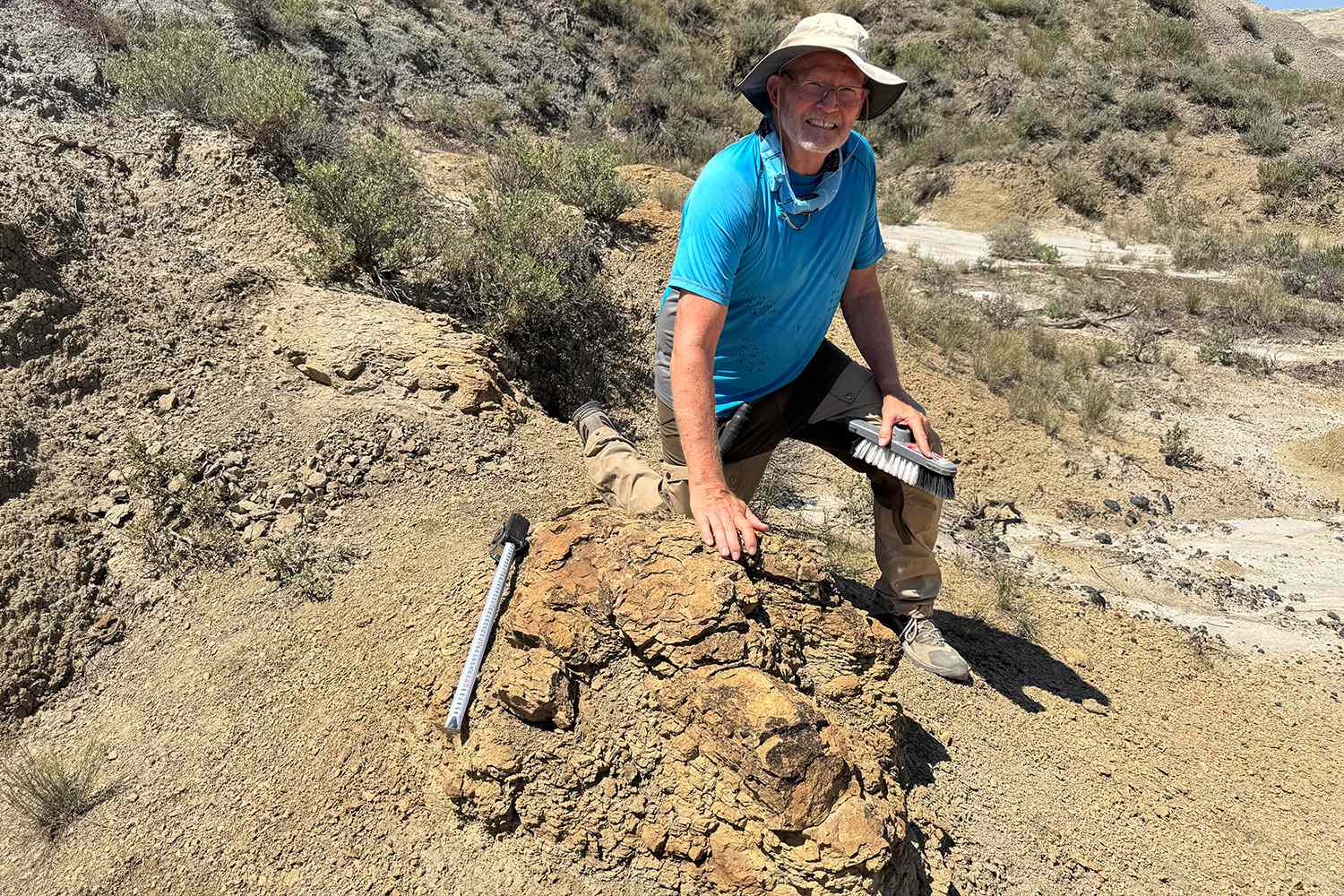
“I’m always telling my students that science starts with curiosity, passion and careful observation,” Kent Hups said of his discovery
Credit: Tyler Lyson
NEED TO KNOW
- A Colorado teacher made the first-ever discovery of a adult T. rex trackway while volunteering on a fossil dig in 2025
- The trackway, made 66.5 million years ago, includes four three-foot-long footprints spanning about 23 feet
- The Denver Museum of Nature & Science will display the rare find, offering a glimpse into T. rex behavior
A Colorado high school teacher with a passion for amateur fossil hunting made a prehistoric discovery in North Dakota.
In 2025, Kent Hups was volunteering on a dig in the Upper Cretaceous Hell Creek Formation of southwestern North Dakota led by his friend Tyler Lyson, senior curator of vertebrate paleontology at the Denver Museum of Nature & Science, when he found what he believed to be a T. rex footprint, according to Smithsonian Magazine and the Denver Museum of Nature & Science.
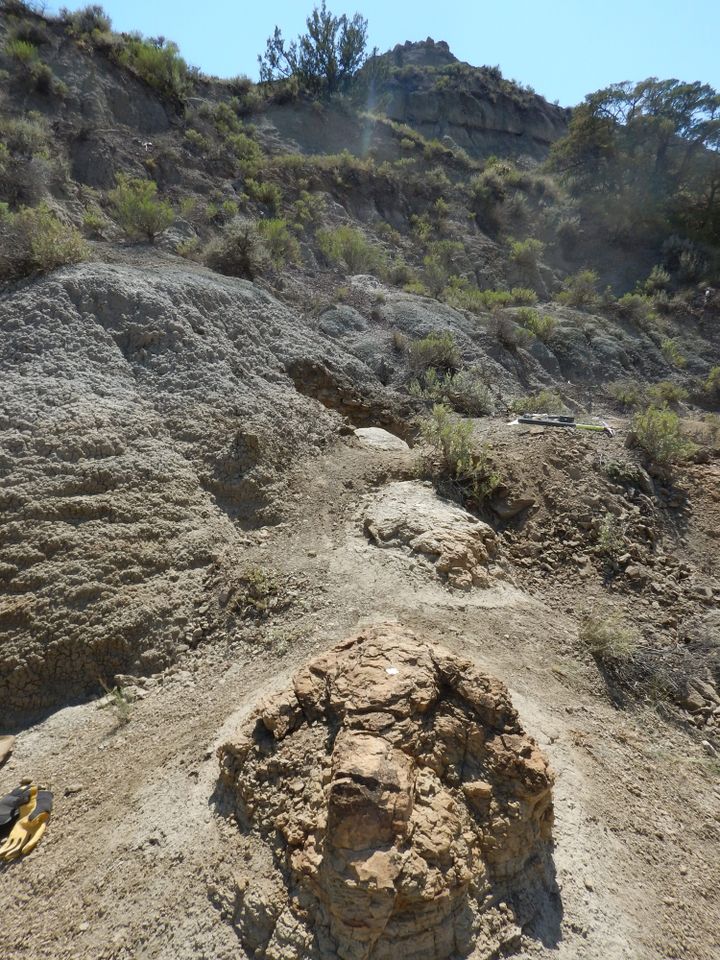
Credit: Kent Hups
Upon first glance, Lyson and others on the dig weren’t entirely convinced, but they returned the next day and were able to confirm that Hups hadn’t just uncovered one adult T. rex footprint, but four — leading researchers to the first-ever discovery of an adult T. rex trackway.
“As a teacher, I’m always telling my students that science starts with curiosity, passion and careful observation. I never imagined that could lead me to a discovery like this,” Hups, a teacher at Northglenn High School, said in a statement to the Denver Museum of Nature & Science.
Hups also served as a co-author in an article on the findings published in the Journal of Vertebrate Paleontology on Sept. 8.
Researchers estimate the trackway was made around 66.5 million years ago.
The trackway is described as “exceedingly rare.” It’s made up of tridactyl tracks that are approximately 1 meter in length, or about 3 feet long, and extends for about 23 feet, indicating that the adult T. rex was walking at a speed of approximately 3.4 to 4.5 miles per hour.
“The tracks are preserved as fine-grained sandstone concretions cemented with calcium carbonate that nucleated around footprint depressions and the resultant footprint casts are harder than the surrounding rock,” the researchers wrote.
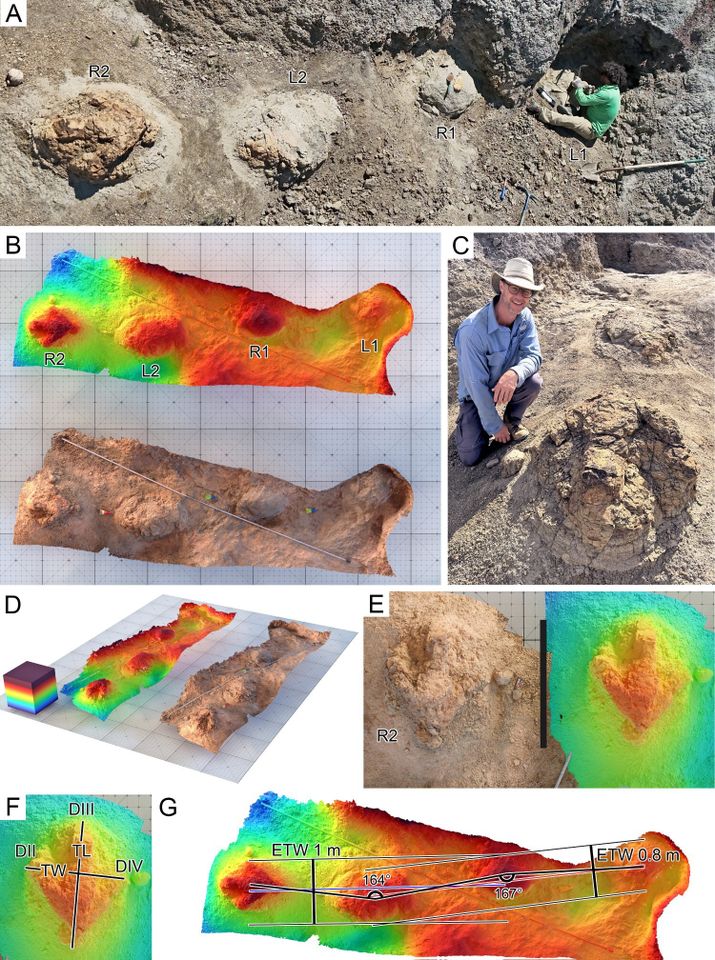
Credit: Falkingham, P. L., Hups, K. M., Tamez-Galvan, E. M., Bercovici, A. D., & Lyson, T. R. (2026). A large tridactyl trackway from the Upper Cretaceous Hell Creek Formation of North Dakota, likely attributable to an adult Tyrannosaurus rex. Journal of Vertebrate Paleontology.
While the footprint casts have become “heavily fractured” and faced other damage since the Cretaceous period, the discovery is an “important data point that marks the first report of a trackway that is likely attributable to an adult Tyrannosaurus rex.”
“Bones tell us an enormous amount about these animals, but footprints capture a moment of behavior. With a trackway, we can actually follow an animal as it moved across the landscape. That is incredibly rare for T. rex,” Lyson said in a statement to the Denver Museum of Nature & Science.
Never miss a story — sign up for PEOPLE’s free daily newsletter to stay up-to-date on the best of what PEOPLE has to offer, from celebrity news to compelling human interest stories.
According to the museum and Smithsonian, isolated footprints have been attributed to adult T. rex in the past in New Mexico and Montana, but “this is the first time scientists have described a sequence of tracks, or trackway, likely left by this most famous of dinosaurs.”
Peter Falkingham, a professor of palaeobiology at Liverpool John Moores University and a dinosaur track expert, was the lead author of the study. Other Museum researchers include Evan Tamez-Galvan and Antoine Bercovici.
The Denver Museum of Nature & Science will house the T. rex trackway, and plans are underway for the find to go on display at the museum this winter.
Read the full article here