George Campbell couldn’t bring himself to drive past the site where he searched for his fallen brothers. Now, he spends his days there telling stories he says the world can’t forget
Credit: Courtesy of George Campbell
NEED TO KNOW
- Retired FDNY firefighter George Campbell was on the scene the day the Twin Towers fell on Sept. 11, 2001
- While he avoided the site for years after the attack, he now volunteers there as a docent for the 9/11 Memorial & Museum
- “It was important for me that we keep the story alive,” Campbell says
For 23 years, George Campbell actively avoided the area near the World Trade Center where the twin towers once stood. “I would literally go out of my way to drive and not pass it,” he says.
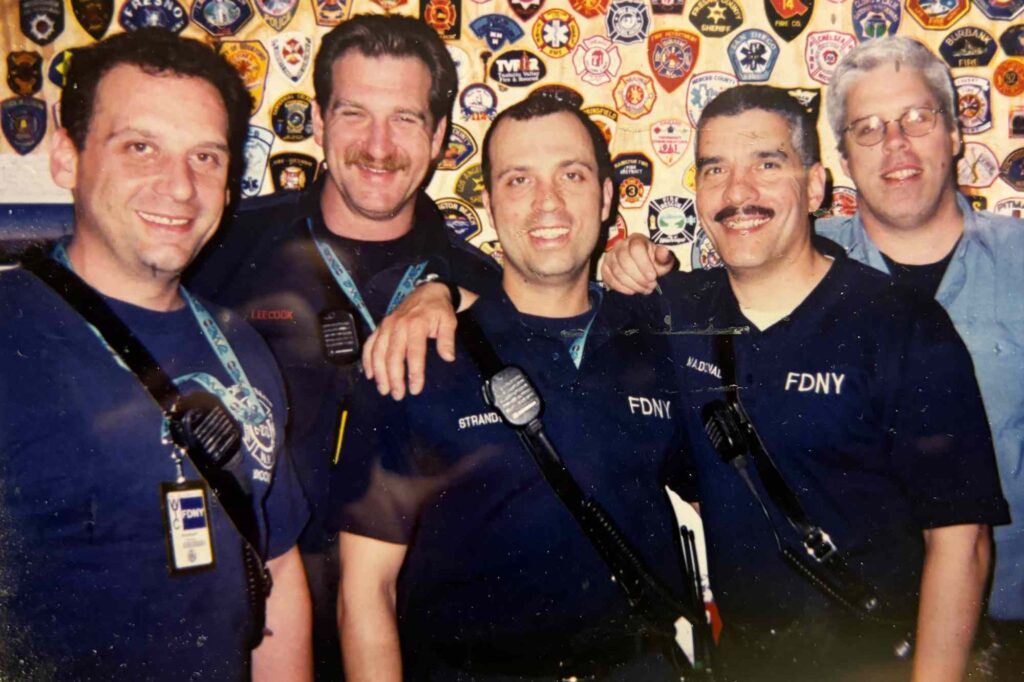
But since March of 2025, after retiring from a 37-year career with the New York City Fire Department, Campbell not only returned to the site where so many of his friends were killed, but decided to volunteer there as a docent for the 9/11 Memorial & Museum.
“It was important for me that we keep the story alive,” Campbell tells PEOPLE. Several times a month, he shows for his shift before 9:30 a.m. and stays for seven hours.
Visitors from across the world soon discover that the loquacious man with the quick smile was with the FDNY on Sept. 11, 2001 — and had spent 10 months recovering victims’ remains from the rubble that once covered the ground where they stand in exhibit halls.
On the morning of the attacks, Campbell was on medical leave and planned to drive from his home north of New York City to a doctor’s appointment in Brooklyn.
But when his fifth-grade daughter missed the school bus, this father of five drover her to school. The delay put Campbell on the George Washington Bridge just as the second hijacked plane slammed into the South tower of the World Trade Center.
“I saw that explosion,” he recalls.

Credit: Courtesy of George Campbell
Campbell immediately drove to his South Bronx firehouse. “And then we literally just stopped a city bus, got everybody off, told the guy, ‘you’re driving us down,’ ” he says.
The driver, “an old Korean War vet,” had no idea what was happening until Campbell pointed to a black cloud of smoke rising over southern Manhattan. “We’re under attack,” Campbell recalls telling the driver.
As Campbell and the other firefighters just about reached the World Trade Center, the North tower collapsed.
Kids, he says, often ask what was going through his mind that day.
“It’s a great question. Every guy was like, ‘All right, we got to get to work.’ You can’t process the fact that a couple thousand people just died,” he says. “You don’t think it, you very much are like, ‘All right, we have to get to work.’ ”
For the next two days, he and his fellow firefighters combed the rubble, seven stories high at the time. “You would literally just lay in the dust because it was like a cloud,” he says. “It was like you would lay in it like you were in a bed.”
People would come to the piles with wicker baskets filled with water, sandwiches, cigarettes.
“I remember thinking, ‘That’s amazing,’ ” he says.
Campbell spent ten months on the recovery operation. Assigned to a specialized GPS unit, he helped document the precise locations where body parts and artifacts were found.
“We found a pair of boots with just the legs and the feet in them. Our unit had a way to identify all the firemen, anything that could possibly identify this guy, we had it,” he says. “And I knew the guy.”
The finding shook the usually unflappable Campbell, who worked as an emergency room nurse for 30 years at a large New York City hospital. “It was personal,” he says.
In attempting to convey to museum visitors the shocking enormity of the destruction, “I tell people there were 220 stories or floors of office space. We did not find one chair, one desk, one phone, one computer, nothing but steel and dust down here,” he says.
After avoiding the site for more than two decades, Campbell began reconsidering after a series of shoulder injuries forced him into retirement.

Credit: Courtesy of George Campbell
He’s especially struck, he says, by how emotional international visitors get, particularly Europeans. “They remember that day, they’ll tell you what they were doing, how the whole world stopped, and they get even emotional. I’m like, ‘That I never saw coming.’ ”
Kids are Campbell’s favorite visitors. “Ask away,” he says he tells them. “What questions?” He carries commemorative pins and hands them out to children who ask what he considers a particularly good question.
One boy, Campbell says, spent an hour and a half trying to stump him with questions — and finally succeeded with a trivia question about the nearby Oculus transportation and shopping hub. “It was like two sumo wrestlers going on,” Campbell says, laughing.
Never miss a story — sign up for PEOPLE’s free daily newsletter to stay up-to-date on the best of what PEOPLE has to offer, from celebrity news to compelling human interest stories.
When he’s not volunteering with the 9/11 museum, Campbell, who now lives on the beach in a section of Queens, enjoys visits with his seven grandchildren. He also travels with a 9/11 exhibit that educates people across the country about the attacks.
“I like keeping the memory alive,” Campbell says. “And I like trying to stress the good points, and that there was a unity in this country that was amazing.”
Read the full article here