

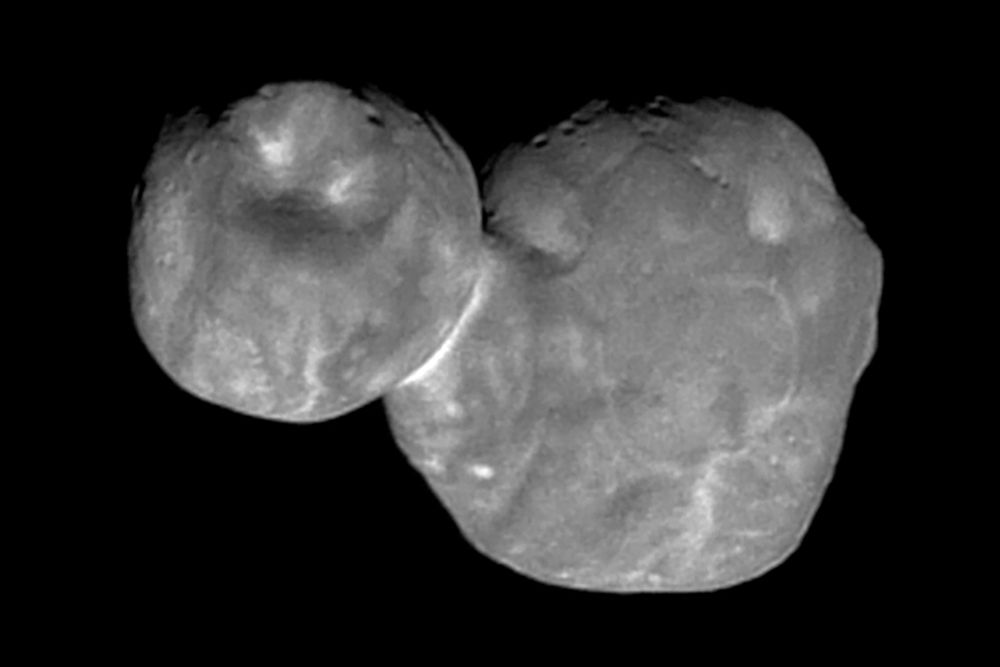
Jackson Barnes, a graduate student at Michigan State University, created a simulation that reproduces the objects "naturally with gravitational collapse"
NEED TO KNOW
- Graduate student Jackson Barnes appears to have solved how snowman-like objects in space are formed
- He created a simulation that reproduces the objects known as Arrokoth
- NASA first spotted the objects with the Hubble Space Telescope in 2014, then conducted a flyby in 2019
A college student seems to have cracked the code as to how snowman-like objects floating at the outer edges of the solar system are formed.
Jackson Barnes, a graduate student at Michigan State University, created a simulation that reproduces the objects "naturally with gravitational collapse," MSU Today shared on Monday, Feb. 16.
"We’re able to test this hypothesis for the first time in a legitimate way," Barnes said. "That’s what’s so exciting about this paper."
The paper was published in the Monthly Notices of the Royal Astronomical Society – Oxford University Press for March by authors Barnes, Stephen Schwartz, from the Planetary Science Institute of Tucson, Arizona, and Seth Jacobson, of MSU.
“Gravitational collapse fits nicely with what we’ve observed," Jacobson, an Earth and Environmental Science Assistant Professor, told the college outlet.
NASA first discovered these objects, called Arrokoth, in 2014, and has debated their origins since. However, a YouTube video of Barnes' simulation shows two objects becoming "contact binaries" and joining together to create the resemblance of a snowman.
“If we think 10% of planetesimal objects are contact binaries, the process that forms them can’t be rare,” Jacobson added to MSU Today.
The Arrokoth objects were found by NASA's New Horizons spacecraft's science team with the Hubble Space Telescope. Then, in 2019, the space organization conducted a high-speed flyby to explore the Arrokoth.
"The strange shape of Arrokoth, unlike any object previously visited, was the biggest surprise of the New Horizons spacecraft’s flyby," according to NASA's page about Arrokoth.
They are located in the Kuiper Belt, a region on the solar system's outer edge that includes Pluto, comets and other small planets made of dust and ice, according to the Detroit Free Press.
Read the full article here