
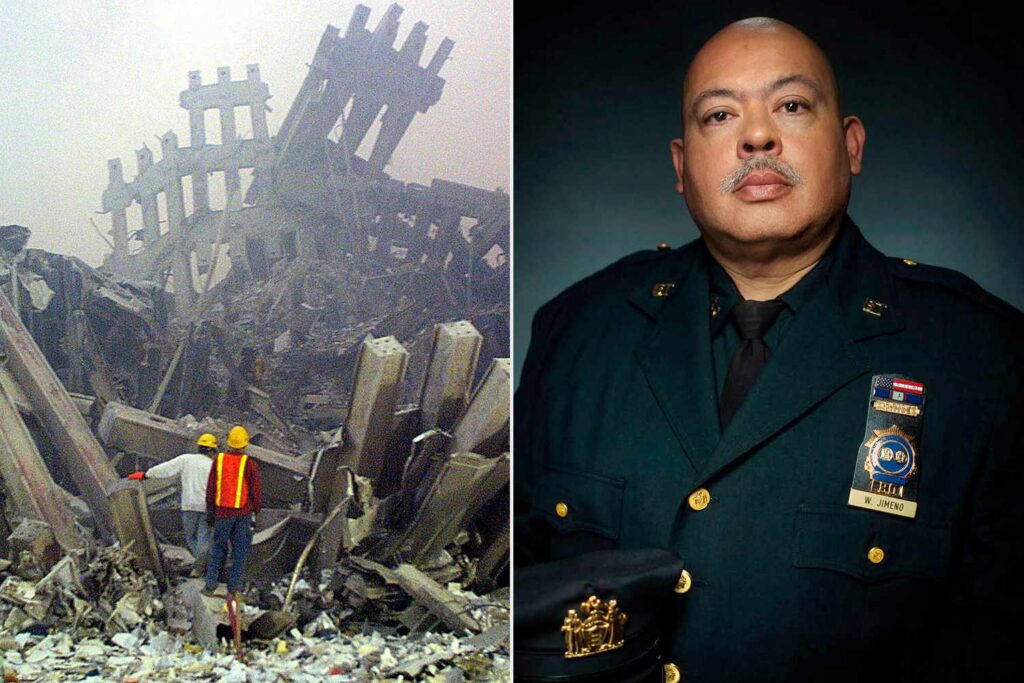
Port Authority Police Officer Will Jimeno was pulled from the rubble in Manhattan after being trapped for 13 hours
Credit: DOUG KANTER/AFP/Getty; Courtesy 9/11 Day
NEED TO KNOW
- Port Authority Police Officer Will Jimeno was pulled from beneath rubble on Sept. 11, 2001
- He spent 13 hours pinned beneath a slab of concrete and was gravely wounded
- Jimeno was rushed to Bellevue Hospital in New York City, where he underwent eight surgeries
After rescuers finally pulled Port Authority Police Officer Will Jimeno from beneath the rubble of the collapsed World Trade Center towers late on Sept. 11, 2001 — following 13 hours pinned beneath a slab of concrete and gravely wounded — he looked up at the late-night sky.
“Where is everything?” Jimeno asked a firefighter.
“It’s all gone, kid,” he replied.
Speaking to PEOPLE now, Jimeno says,“That’s the first time I cried. I didn’t cry when I got hurt. I didn’t cry when the guys died,” referring to partners Dominick Pezzulo, Antonio Rodrigues and Christopher Amoroso, who’d been by his side when the towers crumbled.
“I cried when I saw that the buildings were gone,” he continues, “because I knew how many people were still within those towers.”
Rushed to Bellevue Hospital, Jimeno experienced another shocking surprise: An empty emergency room. “All these doctors and nurses are just standing around and I said, ‘Where is everybody?’ They’re like, ‘You’re it,’ ” he recalls. “I’m like, ‘How could that be?’ ”
That night, Jimeno almost died, flatlining twice. “They had to cut me open because my muscles were dying,” he says. Doctors made long surgical incisions along his left leg, from his hip to his ankle, and along his inner calf and thigh.

Credit: Mary Kang
The damage remains. “I literally still have a hole [in my leg] you can put your finger in,” says Jimeno, whose left leg is partially paralyzed and, some days, doesn’t work at all.
While hospitalized, he underwent eight surgeries, including skin grafts taken from his right leg to cover the wounds on his left. “I was drugged up,” he says. “I was suffering so much pain from the operations.”
His spirits were buoyed by his wife Allison, who was then pregnant with their second child and remained a constant presence by his bedside. “Her strength is something that carries me till today,” Jimeno says.
Another emotional boost came from his 4-year-old daughter Bianca when she visited that October, the first time he’d seen her since the morning of Sept. 11.
“She walked into the room and said, ‘Hi, Daddy,’ with a little pumpkin that she selected for me, and came up and gave me a kiss,” he recalls.
“I cried quite a bit. I was just so happy to see her. I was in so much pain, I still couldn’t walk, but it was just a special moment. It really made me feel like, ‘Okay, you actually survived this,’ ” he says.
After more than a month at Bellevue, Jimeno continued his in-patient recovery at Kessler Rehabilitation Institute in West Orange, N.J.
“I started the process of learning how to literally walk again, how to dress myself again,” he recalls. “They told me, ‘You work hard and we’ll get you in a wheelchair so you could be there for the birth of your daughter.’ ”
On Nov. 26, 2001, his 34th birthday, Jimeno sat in a wheelchair by Allison’s side as she gave birth via a scheduled C-section to their daughter Olivia. “What a birthday gift,” he tells PEOPLE. “I can’t think of anything better. It was truly amazing.”
Jimeno returned home in December in time to celebrate Christmas with his family. At first, he says, “things were good.” But soon the psychological toll of what he had survived emerged.
Never miss a story — sign up for PEOPLE’s free daily newsletter to stay up-to-date on the best of what PEOPLE has to offer, from celebrity news to compelling human interest stories.
“I didn’t know there was something wrong with me,” he says. “There were a lot of things that I’m not proud of, or who I became.”
After what he describes as “a bad incident at home,” Jimeno sought therapy for PTSD. He found that talking about what he had endured and sharing his story has helped him heal.
“You have to move forward,” he says. “And pain is something that should motivate you again to find your sunrise.”
Read the full article here